What Is Honeycomb Corneal Edema?
Honeycomb corneal edema is a distinctive pattern of epithelial swelling seen in some patients, especially those with corneal endothelial disease who are treated with ROCK inhibitors like netarsudil.
What Causes It?
The main drug associated with this condition is:
• Netarsudil – a ROCK inhibitor commonly used for glaucoma.
When used in patients with pre-existing endothelial dysfunction, netarsudil may alter the tight junctions between epithelial cells, allowing fluid to accumulate in the corneal epithelium. This leads to the honeycomb pattern of edema.

⸻
When Does It Happen?
Honeycomb edema has been observed in:
• Patients with Fuchs’ endothelial dystrophy
• Post-operative eyes after cataract surgery
• Eyes treated with netarsudil during corneal recovery (such as after Descemet stripping only, or DSO)
It is rarely seen in healthy eyes using netarsudil for glaucoma management.
⸻
What Does It Look Like?
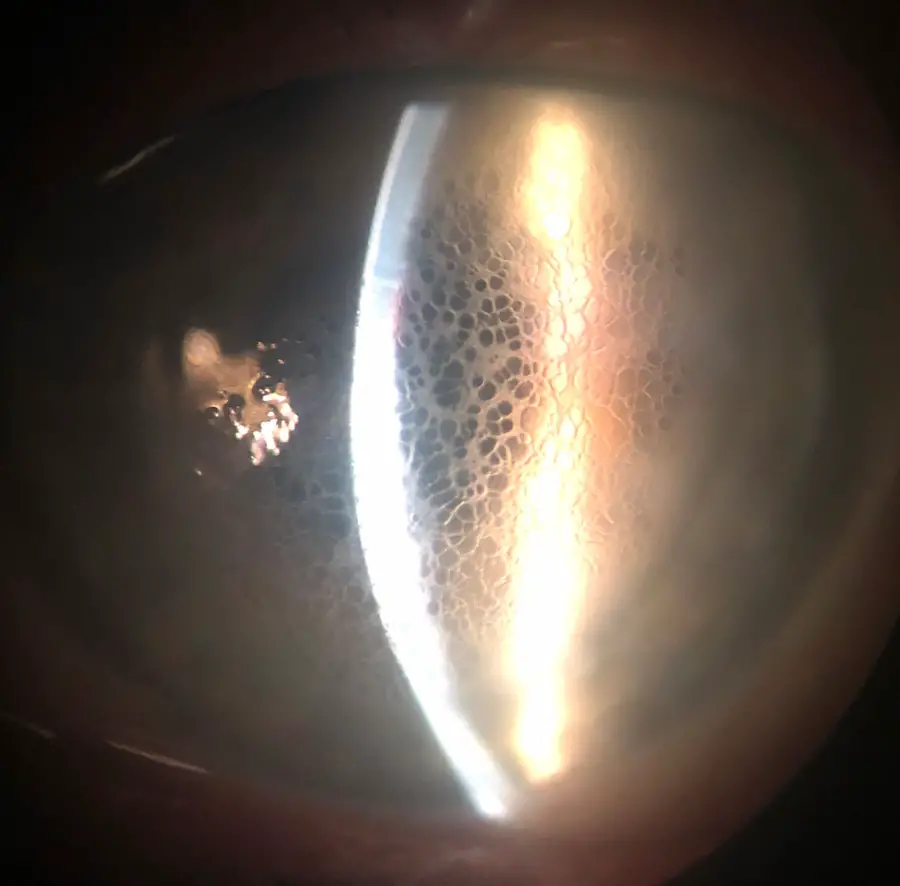
• Multiple small, round, fluid-filled areas in the epithelium
• Uniformly arranged in a honeycomb-like pattern
• Best viewed with slit-lamp biomicroscopy or anterior segment OCT
⸻
Is It Dangerous?
Honeycomb corneal edema is not dangerous. It:
• Is often self-limiting
• May resolve on its own with continued use of netarsudil
• Can also resolve if the drug is discontinued
• Does not indicate treatment failure or permanent damage
Close monitoring is still recommended, especially during the early treatment phase.
⸻
Key Points for Optometrists
• Honeycomb edema is a known side effect of netarsudil in patients with endothelial compromise.
• It is a temporary change and does not require emergency treatment.
• Patient education and follow-up are important to reassure and monitor progress.
• Be sure to differentiate honeycomb edema from infectious or inflammatory corneal changes.
⸻
Summary
Honeycomb corneal edema is a reversible side effect of netarsudil therapy, seen mostly in patients with existing corneal endothelial disease. It appears as a grid-like epithelial swelling but usually resolves without complications. For new optometrists, understanding this condition helps ensure accurate diagnosis and appropriate patient care.
Discover more from An Eye Care Blog
Subscribe to get the latest posts sent to your email.
You must be logged in to post a comment.