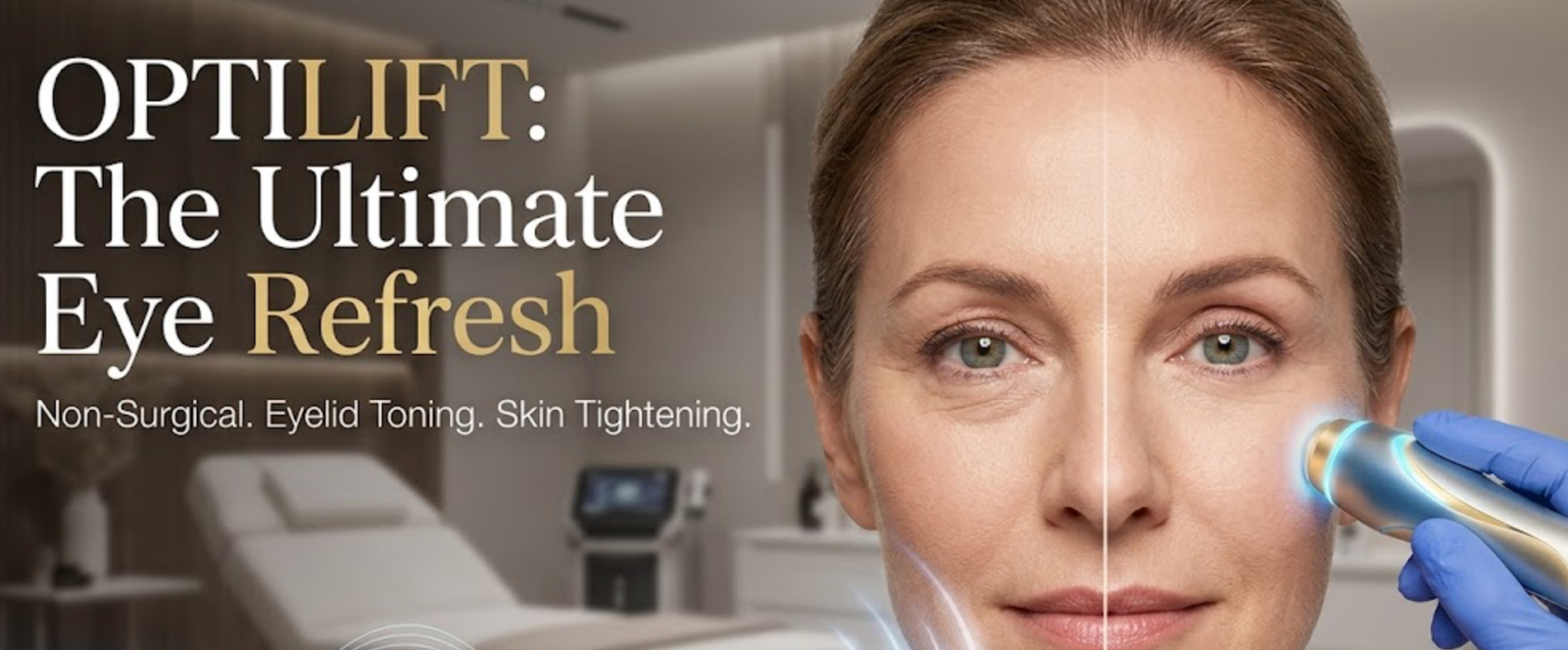
OptiLIFT: The New Era of Non-Surgical Eye Rejuvenation
Do your eyes look tired even when you’re well-rested? As we age, the delicate skin and muscles around our eyes—the periorbital area—naturally lose their elasticity. This leads to sagging lids, “heavy” eyes, and even functional issues like chronic dryness.
Enter OptiLIFT, a breakthrough in non-invasive aesthetic technology. Designed to treat the actual cause of eye aging rather than just masking the symptoms, this procedure is quickly becoming the gold standard for those seeking a refreshed look without the scalpel. [1]
What is OptiLIFT?
OptiLIFT is a non-surgical, dual-action treatment designed to firm the skin and tone the muscles around the eyes. Unlike traditional blepharoplasty (eyelid surgery), OptiLIFT requires no needles, no incisions, and zero downtime.

The system utilizes a proprietary combination of two advanced technologies:
- Dynamic Muscle Stimulation (DMSt): This “works out” the tiny muscles responsible for lifting the eyelid and maintaining a crisp blink.
- Radiofrequency (RF) Energy: This gently warms the deeper layers of the skin to stimulate collagen production and tighten loose tissue. [2]
The “Blink” Benefit: Beauty Meets Function
Most people think of eye aging as a purely cosmetic problem, but it is often tied to functional health. Over 60% of peoplewith dry eye symptoms suffer from “incomplete blinking” caused by weakened eyelid muscles. When you don’t blink fully, your eyes aren’t lubricated properly.
OptiLIFT addresses this by strengthening the periorbital muscles. By restoring the “snap” to your eyelids, the treatment improves tear film stability, reducing the gritty, burning sensation associated with chronic dry eye. [3]
Types of OptiLIFT Treatments and Packages
While “OptiLIFT” is the core technology, providers often offer different “types” of treatments depending on whether your goal is purely aesthetic, functional (for dry eye), or a comprehensive combination of both.
1. The Standard Periorbital Lift (DMSt + RF)
This is the most common “type” of OptiLIFT session. It utilizes the dual-action of Dynamic Muscle Stimulation and Radiofrequency specifically on the upper and lower eyelids. It is the primary choice for patients looking to correct eyelid laxity and “tired eyes.” [4]
2. Full-Face OptiLIFT (The “TriLIFT” Protocol)
Some advanced clinics offer OptiLIFT as part of a full-face contouring session. In this configuration, the DMSt technology is applied not just to the eyes, but also to the cheekbones and jawline to provide a non-surgical facelift effect by toning the larger facial muscle groups. [5]
3. “Triple Threat” Combination Therapy (IPL + RF + DMSt)
For patients suffering from severe inflammation and dry eye, OptiLIFT is often typed as a “Triple Therapy.” This package combines:
- OptiLight IPL: To treat inflammation and redness.
- Radiofrequency (RF): To melt oil blockages in the glands.
- OptiLIFT (DMSt): To strengthen the blink and lift the lids. [6]
4. Functional Blink Therapy
This specialized application focuses less on wrinkles and more on the mechanics of the eye. It is frequently recommended for patients with “Incomplete Blink Syndrome” or those recovering from conditions like Bell’s Palsy, where muscle tone in the eyelid has been compromised. [7]
At a Glance: OptiLIFT Treatment Comparison
| Treatment Type | Focus Area | Primary Benefit |
|---|---|---|
| Standard OptiLIFT | Eyelids / Under-eye | Toning & Skin Tightening |
| Full-Face OptiLIFT | Eyes, Cheeks, Jaw | Total Facial Recontouring |
| OptiLIFT + IPL | Eyelids & Tear Film | Dry Eye Relief & Redness Reduction |
| Blink Therapy | Lower Eyelid Muscles | Improved Lubrication & Eye Health |
Which OptiLIFT Treatment is Right for You?
Select the best answer for each question to see your recommendation.
Why Choose OptiLIFT?
If you are considering an eye lift but aren’t ready for the operating room, OptiLIFT offers several distinct advantages:
- Immediate Results: Many patients notice a brighter, more “awake” look after just one or two sessions.
- Quick Sessions: A typical treatment takes only 15 to 20 minutes, making it a perfect “lunch break” procedure.
- Safety Profile: Because it is non-invasive, the risk of scarring or infection is virtually non-existent compared to surgery.
- No Recovery Time: You can apply makeup and return to your daily activities immediately after the appointment.
Who is the Ideal Candidate?
OptiLIFT is highly effective for individuals experiencing mild to moderate eyelid sagging, under-eye bags, or “tired eye” syndrome. However, because it uses DMSt technology, patients with pacemakers or certain implanted electronic devices should consult with their provider first to ensure safety. [8]
For the best results, practitioners generally recommend a series of four treatments spaced one week apart. This allows the collagen remodeling process to reach its peak, providing a natural, long-lasting lift.
References
- Clinical Aesthetics Journal: Trends in Non-Invasive Periorbital Rejuvenation (2025).
- Lumenis Medical Systems: The Science of DMSt and RF Integration in OptiLIFT Technology.
- Ophthalmology Times: Evaluating the Link Between Eyelid Muscle Laxity and Evaporative Dry Eye.Accuvision Dry Eye: OptiLIFT: Restoring Tone and Firmness to Eyelids (2025).
- Eye Doctor MD PC: Full Face Rejuvenation: Beyond the Periorbital Area.
- Dermatology News: Comparing Surgical Blepharoplasty vs. Energy-Based Lid Tightening.
- Global Med-Tech Standards: Safety Protocols for Dynamic Muscle Stimulation Devices.
Discover more from An Eye Care Blog
Subscribe to get the latest posts sent to your email.


You must be logged in to post a comment.