In a first-of-its-kind surgery, a team led by a University of Maryland Medical Center (UMMC) neurosurgeon has successfully removed a rare cancerous tumor wrapped around the spine and spinal cord of a 19-year-old woman – through her eye socket (orbit).
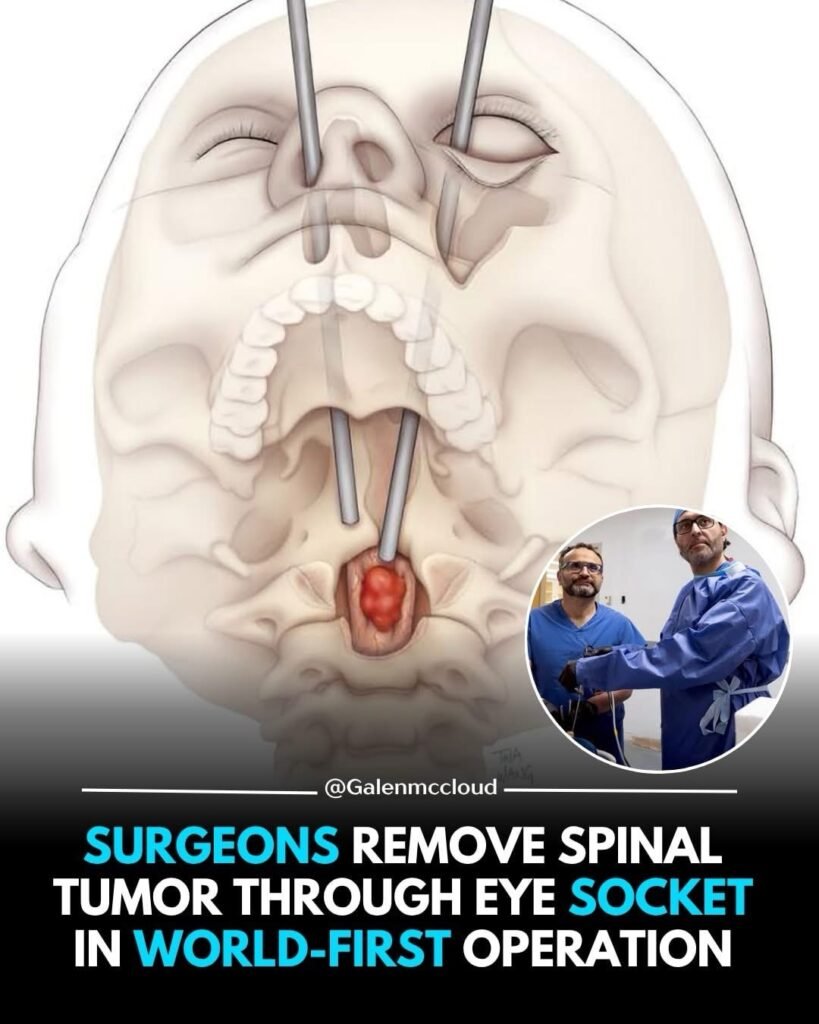
Although surgeons use a “transorbital” approach to access tumors in the brain and sinuses, this is the first time it has ever been used to remove a spinal tumor. In this case, the young woman had a slow-growing developmental bone tumor called a chordoma in her spine. Only about 300 chordomas are diagnosed in the United States every year.
“The tumor was wrapped around the patient’s spine and spinal cord and had invaded the vertebrae in her neck, just below the base of the skull,” said Mohamed A.M. Labib, MD, CM, a UMMC neurosurgeon and Assistant Professor of Neurosurgery at the University of Maryland School of Medicine (UMSOM). “By going through the bottom of the eye socket, we were able to remove a tumor that otherwise would have been very difficult and very risky to address.”

Dr. Labib said that trying to reach the tumor from the back could have risked damaging the spinal cord. “We also avoided disturbing or damaging key structures such as the eustachian tube, major blood vessels such as the jugular vein and internal carotid artery, and nerves that control swallowing and speech,” he said.
He added, “We created a huge surgical corridor that enabled us to get in front of the spinal cord. It was a straight shot.”
The patient, who has no evidence of cancer, required multiple surgeries and received extraordinarily complex care from a multidisciplinary team of physicians that included neurosurgeons, skull base and facial plastic surgeons and radiation oncologists.
In addition to the spinal tumor, she also had a very large chordoma that was wrapped around her brain stem, a critical structure which controls many vital functions. In two separate procedures, UMMC surgeons removed part of the tumor by opening her skull in a traditional craniotomy and then took out the rest by accessing the area through her nose. Both the transorbital and endonasal procedures involved the use of an endoscope, a thin, lighted tube with a camera at the end.
“Utilizing open and endoscopic surgical techniques that respect the anatomical boundaries that we face – and devising innovative ways to reduce morbidity – is really central to Dr. Labib’s 360-degree approach to treating these types of tumors,” said Andrea M. Hebert, MD, MPH,a head and neck surgeon and an Associate Professor of Otorhinolaryngology-Head and Neck Surgery at UMSOM who performed the endonasal procedure and took part in the transorbital surgery.
“These tumors are definitely life-threatening when they grow to the point where they cause significant brain stem compression, so surgery is the best way to try to save a patient’s life,” Dr. Hebert said. “Many of these tumors recur, and that’s why we favor a multidisciplinary approach to treatment.”
The Third Nostril
Dr. Labib developed the novel surgical plan to remove the spinal tumor after exploring the transorbital approach in the Department of Neurosurgery’s Skull Base 360° Laboratory using cadavers. He called the eye socket, “the third nostril,” in preliminary research looking at new ways to access hard-to-reach skull base tumors published in the Journal of Neurosurgery in October 2023.
In addition to the three surgeries last spring, the patient, Karla Flores, now 20, of Rosedale, MD, was treated with proton radiation therapy to destroy any lingering cancer cells. A neurosurgeon also fused the C1 and C2 vertebrae in her neck to stabilize the spine.
“Karla is doing very well. I am happy that through a very coordinated multidisciplinary team effort she had such a successful outcome,” Dr. Labib said, noting that she has some lingering issues with moving her left eye as the result of nerve damage from the tumor abutting the brain stem.
Flores recalled that she started experiencing double vision when she was 18 and tried unsuccessfully for months to learn the cause. “For a while, I didn’t know what was happening to my health. It felt like no one understood or even believed that there was a physical reason for my symptoms. Then I saw my ophthalmologist who gave me hope because she believed that something was wrong and referred me to Dr. Labib,” Flores said.
“I was so relieved when I met Dr. Labib and the team at the University of Maryland Medical Center. They listened and took me seriously. Learning about the spinal and brain tumors was terrifying, but I am so grateful that the doctors were able to remove them. I’m slowly recovering and with any problem I have, they help me,” Flores continued.
Believing in Myself
“I keep reminding myself to take one day at a time and know that each step is an accomplishment. I’m also glad I stood my ground and kept looking for help until I found it. Things could have gone horribly wrong if I didn’t believe in myself,” Flores said. She plans to go to school to become a manicurist.
In other transorbital procedures, surgeons have made incisions next to or above the eye. In this case, Dr. Labib worked with a facial plastic and reconstructive surgeon, Kalpesh T. Vakharia, MD, who carefully cut through the conjunctiva, the transparent membrane protecting the eye, inside the lower eyelid without disturbing the eye. That process also involved making an incision inside the patient’s mouth. Dr. Vakharia removed the bottom of the eye socket, and a portion of the cheek bone, to carve out a large enough pathway for surgeons to thread surgical tools into the sinus to reach the cervical spine.
“We wanted to develop a surgical plan where there would be no external scars and it would be impossible to tell that the patient even had surgery,” said Dr. Vakharia, Chief of Facial Plastic and Reconstructive Surgery in the Department of Otorhinolaryngology-Head and Neck Surgery and Director of the Facial Nerve Center at UMMC and an Associate Professor of Otorhinolaryngology-Head and Neck Surgery at UMSOM.
Working in tandem with Dr. Hebert, Dr. Labib was able to drill through bone in the vertebrae to access the tumor and painstakingly dissect it, using a variety of surgical instruments.
After the tumor was removed, Dr. Vakharia rebuilt the bottom of the eye socket using a titanium plate and rebuilt the cheek with bone from the patient’s hip. He said of the experience, “It was amazing to have had the opportunity to be part of surgery that had never been done before.”
For UMMC President and CEO Bert W. O’Malley, MD, surgical innovation is a fundamental tenet of academic medicine and a core driver of the medical center’s culture. Dr. O’Malley is an internationally renowned head and neck cancer surgeon and pioneer of transoral robotic surgery (TORS).
“We are fortunate at UMMC to have a remarkable team of highly skilled surgeon-scientists committed to challenging themselves and inspiring those around them to see each unique case as an opportunity to advance the field,” Dr. O’Malley said. “The complexity of this extremely rare and difficult-to-reach tumor required multidisciplinary perspective, careful planning and precision. The team could have chosen a more standard invasive route, but they charted a novel approach because they wanted the best possible outcome for this young woman, preserving her quality of life. As a surgeon whose career has been shaped by this mindset, I couldn’t be more proud of what this team has accomplished.”
UMMC is the academic flagship hospital of the University of Maryland Medical System, which has 11 hospitals and more than 150 other care locations throughout Maryland.
Medical experts don’t know what causes chordomas, but they arise from remnants of the notochord, which is the precursor of the spine during fetal development. Dr. Labib said it was very rare that Karla had two separate chordomas that were not connected.
A Multidisciplinary Team
Dr. Labib noted that it took a team of physicians from various specialties working together to provide Flores with comprehensive care. “Nobody can do this alone,” he said. He also cited the importance of being able to practice these types of complex surgeries on cadavers “many, many times” before performing them on patients.
“The fact that people are willing to donate their bodies to science enabled us to do this and saved the life of this young woman,” he said.
Timothy J. Chryssikos, MD, PhD, a neurosurgeon at UMMC who specializes in spine surgery and an Assistant Professor of Neurosurgery at UMSOM, performed the spinal fusion surgery. Mark V. Mishra, MD, a radiation oncologist at the Greenebaum Comprehensive Cancer Center at UMMC and the Maryland Proton Treatment Center who specializes in treating tumors of the central nervous system, oversaw Flores’ proton therapy. He is also Director of Clinical Research in the Department of Radiation Oncology and a Professor of Radiation Oncology at UMSOM.
Reblogged from umms.org
Discover more from An Eye Care Blog
Subscribe to get the latest posts sent to your email.


You must be logged in to post a comment.